Industrial Inspection · 25 August 2026
Why Are Drones Preferred for Inspecting Stacks, Tanks and Turbines?
Climbing a stack, entering a tank or reaching a turbine blade with scaffolding: inspecting industrial structures usually carries a working-at-height risk. Drone inspection reaches the same points from a safe distance.
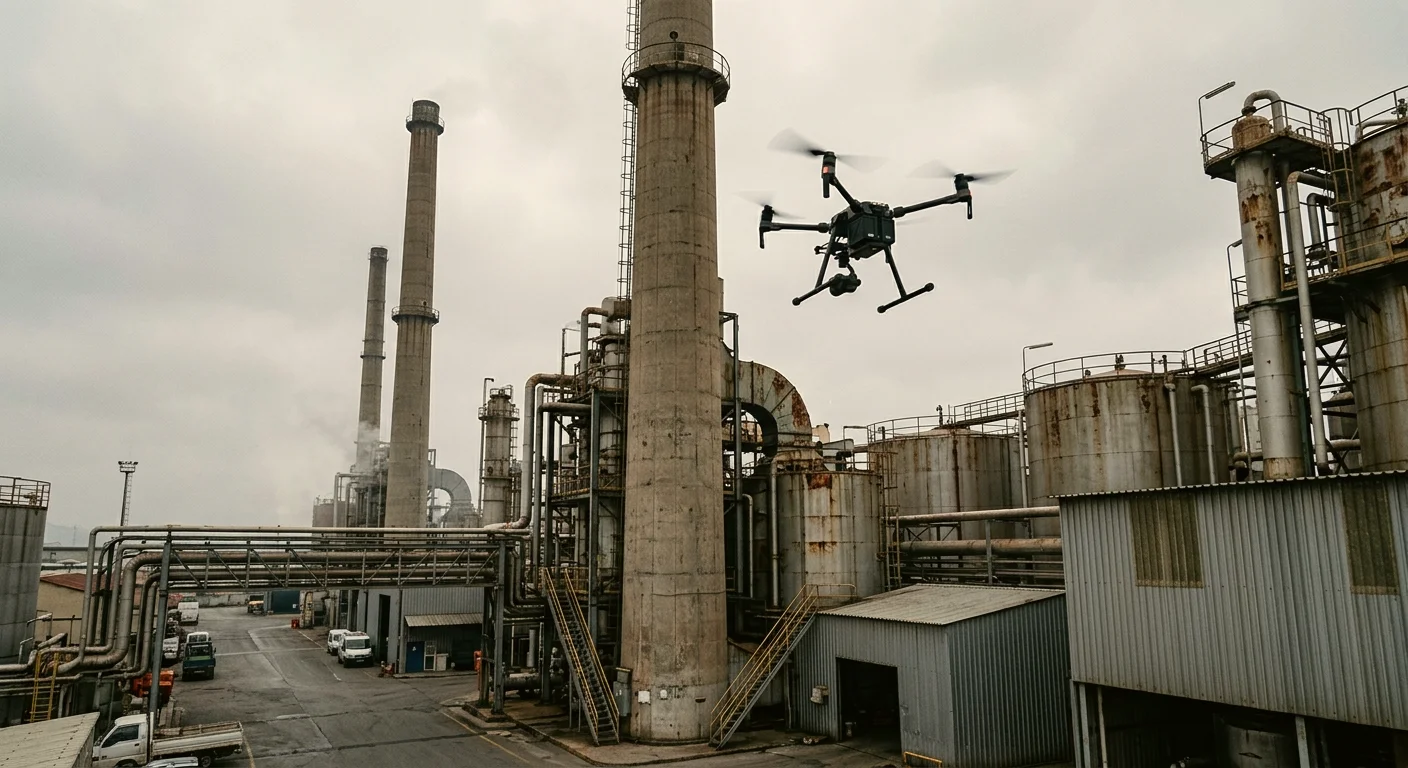
Industrial structures such as stacks, tanks, silos and turbine blades are difficult and risky to inspect with classic methods — climbing, scaffolding, rope access — because of both height and access difficulty. These methods also usually require the relevant part of the plant to be shut down temporarily.
Drone inspection gathers a visual record of hard-to-reach surfaces without requiring work at height, and in most cases while the plant keeps running.
Does the plant need to shut down for inspection?
In most cases, no — an inspection of external surfaces (a stack shell, a tank's outer wall, a turbine blade) can be done while the plant keeps running. Cases requiring internal inspection are assessed separately.
What kinds of damage can be detected?
Surface cracks, corrosion, coating failure, weld-seam deterioration and structural deformation can be spotted with high-resolution imagery; repeated inspections can be compared against previous records.
What is the difference compared to climbing or scaffolding?
Climbing and scaffolding require the team to physically access the structure, which brings both safety risk and set-up/safety-measure time and cost. A drone removes that physical access requirement — the team stays on the ground.
How often should inspections be repeated?
There is no fixed interval; the structure's age, the environmental conditions it is exposed to (chemical vapour, salt air, extreme heat) and previous inspection findings determine the frequency. A site survey recommends a plant-specific inspection schedule.
In short
Frequently asked
Does the plant shut down for inspection?
In most cases, no; external surface inspection can be done while the plant keeps running. Internal inspection is assessed separately.
What damage can be detected?
Surface cracks, corrosion, coating failure and structural deformation can be spotted with high-resolution imagery.
Does the team climb the structure?
No, the team stays on the ground, which removes both the safety risk and the set-up time.
Related services
Looking for a solution for your site?
Tell us what you need and we will assess feasibility together.